A fact-based approach to reallocating distributor investment and Gross-to-Net investment where commercial response could not be directly observed
By Wissam Kahi and Defne Isler
At a glance
- Sector: Special chemicals
- Geographies: Global
- Revenues: €400M+
- Headcount: 730
- Project focus: Incentive program
A pharmaceutical business was experiencing diminishing returns from the commercial investment in the various products and channels. Eendigo helped the business redirect approximately ~20% of that investment toward higher-response products and channels, through a combination of extensive transaction-level data analysis, thorough commercial judgement and cross-functional workshops to ensure alignment across the organization, resulting in a phased GTN optimization program, with sales and profit improvement potential of 3-5%.
Eendigo combined transaction-level analysis, commercial judgment, and cross-functional alignment to develop a phased optimization program, with modeled sales and profit improvement potential.
In Gross-to-Net (GTN) optimization, we help businesses understand how commercial investment is allocated, assess its contribution to growth and profitability and how this allocation has evolved and drifted over time. We then work with the business to align commercial terms with market dynamics and strategic priorities to close the gap between current performance and optimized potential and redesign the principles of the corresponding agreements with the distributors.
Our approach considers both the economic rationale and the relationships required to execute change successfully.
Client Context
Our client was a pharmaceutical business operating across prescription and over-the-counter products, with a commercial model involving distributors, pharmacy channels, and a range of contractual arrangements. Commercial terms, including discounts, rebates, and other forms of investment, played a critical role in supporting market access, distributor relationships, and product competitiveness.
The business managed a Gross-to-Net investment pool of approximately 15% of gross sales. Investment levels varied across products, channels, and commercial partners, reflecting differences in market positioning, historical agreements, and commercial objectives.
Over time, distributor relationships and commercial terms evolved through successive tactical negotiations and changing market conditions. However, without a proper strategic review in many years, these relationships had drifted into arrangements that were suboptimal for the client and, often, for the distributors as well. Thus, the company recognized an opportunity to revisit these terms systematically and ensure that investment continued to reflect current market dynamics, enterprise and customer value, and strategic priorities.
The objective was not simply to reduce commercial spending. It was to improve the quality of revenue by understanding where investment generated the greatest response, while preserving and strengthening the relationships that mattered most, and securing the market access necessary for long-term performance.
Client Challenges
Commercial investment had evolved faster than the mechanisms used to review it
Commercial agreements had developed over time, with different products, channels, and distributors subject to varying terms. In the absence of a consistently maintained centralized view of all contractual conditions, it was difficult to assess whether historical arrangements remained aligned with current business priorities.
This created a need to distinguish between investment that continued to support valuable commercial outcomes and investment that could potentially be redirected. Any changes also needed to consider the importance of distributor relationships and the practical implications of renegotiating established terms.
Fragmented information limited visibility into actual GTN economics
The information required to assess commercial investment was distributed across transaction records, discount and rebate data, credit notes, settlement records, and contractual agreements. These sources needed to be reconciled to establish a reliable view of actual investment by product, channel, and distributor. Without a consolidated fact base, management teams faced challenges in comparing commercial terms consistently and identifying the economic drivers of performance. The diagnostic therefore required both detailed data analysis and input from the commercial teams closest to the market.
Market response was difficult to estimate with precision
Understanding how sales and profitability would respond to changes in commercial investment is foundational to the optimization. However, direct measures of elasticity were not consistently available, and historical data alone could not fully explain distributor or customer behavior.
The business needed a structured way to assess likely responses using available evidence, including market dynamics, competitive positioning, brand reputation, channel characteristics, and behavioral signals. This would allow management to compare opportunities while recognizing the uncertainty inherent in commercial decisions.
Cross-functional alignment was essential to execution
Sales, Finance, and leadership brought different perspectives to commercial investment. Finance had visibility into economic performance, while Sales contributed knowledge of distributor relationships, competitive dynamics, and negotiation realities.
The challenge was to bring these perspectives together around a shared fact base and establish agreement on where investment should be maintained, redirected, or redesigned. A successful program needed to translate analytical findings into decisions that commercial teams could support and implement.
Eendigo Approach
1. Establishing a consolidated view of commercial investment
Eendigo began by engaging management, sales and finance leaders in structured, data-backed discussions to assess commercial performance and build a shared understanding of the key issues.
The team conducted 16 interviews and meetings with country and regional leadership, Market Access and Public Affairs, Finance, and key account management teams. On the data analytics front, the team gathered and reconciled financial and GTN data by product, channel, and partner, together with market share and growth data, CRM documentation, competitive pricing information, credit notes, settlement records, and contractual agreements.
A transaction-level analysis consolidated monthly sales data and approximately 2,000 credit note files, enabling greater visibility into actual commercial investment.
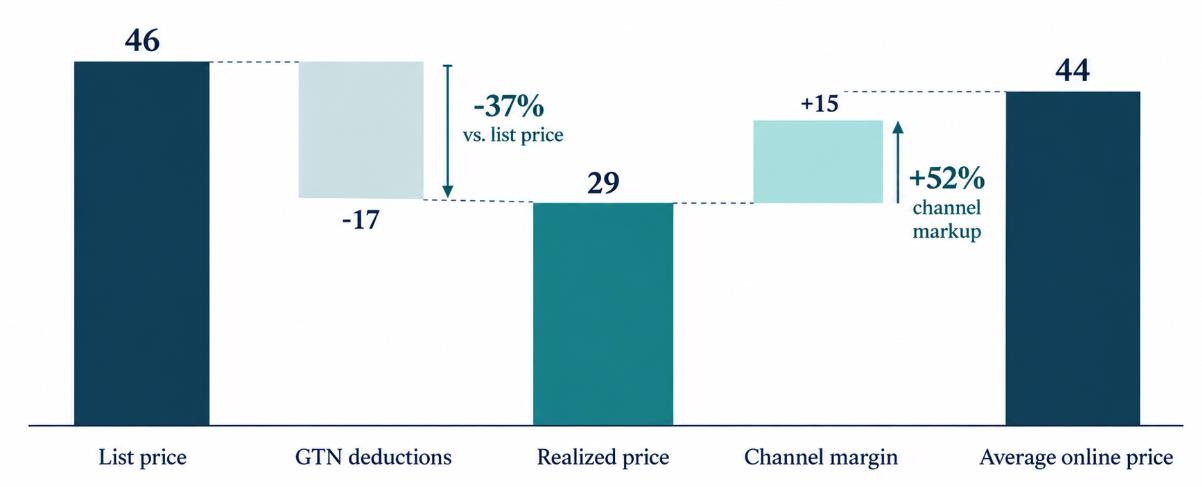
The team used the resulting fact base to develop GTN waterfall analysis, distributor and channel comparisons, and identified potential reallocation opportunities across products and channels. Then, the team organized four workshops around certain product categories, channels, and commercial terms. These sessions helped capture market knowledge, understand existing practices, and, most importantly, achieve organizational alignment on the reallocation principles and the new distributor agreement terms.
Exhibit 1: List-to-net deductions and channel markup create a significant gap between realized and end-market price
Illustrative price waterfall highlights value leakage across the route to market
Source: Eendigo Playbook
2. Translating technical analysis into commercial judgment
The diagnostic was designed to go beyond identifying differences in discount levels. Eendigo assessed the commercial rationale behind existing arrangements and considered how changes could affect distributor behavior, market access, and product performance.
A central element was the development of a framework to reason through elasticity where direct estimates were unavailable or insufficiently reliable. The team used proxies and behavioral signals to assess expected market response, drawing on available evidence such as competitive positioning, market share, channel dynamics, and historical commercial behavior.
These signals were collected from interviews, internal data analysis on past demand and supply behavior, external competitive studies, and primary research on pricing positioning, and helped elaborate an informed view on the responsiveness of various products and channels. Most importantly, these emerging perspectives were discussed thoroughly in the workshops to achieve consensus on the realization.
Finally, these assessments were linked to an analytical model to compare potential reallocation scenarios. The model provided a structured basis for discussion, while commercial judgment was used to interpret assumptions and account for relationship-specific considerations.
3. Turning reallocation opportunities into executable commercial decisions
We translated the analytical findings into a practical reallocation program, distinguishing between changes that could be introduced within existing agreements and those requiring a broader renegotiation of commercial terms.
The team identified where investment could be redirected, defined initial investment corridors by segment, and selected regional champions to test the proposed changes in the market. The roadmap also established how commercial response, competitor reactions, and distributor behavior would inform subsequent decisions, creating a basis for refining the allocation model and progressively introducing more performance-linked commercial mechanisms.
Phase 1 – Initiate reallocation (Months 0-6). The initial phase focused on implementing approximately 30–40% of the planned reallocation. Controlled pilots with selected regional champions were designed to test commercial response, while adjustments to existing discount and sell-in/sell-out mechanisms could be introduced within the framework of current agreements. Initial minimum and maximum investment corridors were also defined by segment.
Phase 2 – Measure & refine (Months 6-12). The second phase focused on measuring in-market response, monitoring competitor and trade reactions, and refining the allocation approach. Commercial agreements and annex conditions could be revisited to incorporate more performance-linked mechanisms. Successful initiatives would be scaled, while less effective changes would be adjusted or reversed.
Phase 3 – Dynamic optimization (Month 12 onwards). The longer-term ambition was to establish a recurring optimization process, supported by periodic reallocations, improved elasticity estimates, and continuous measurement. This would allow the business to adapt commercial investment as market conditions and strategic priorities evolved.
Results Achieved
Beyond identifying the financial opportunity, Eendigo helped translate fragmented information and differing commercial perspectives into a set of actionable decisions and tools for ongoing GTN management.
Key organizational outcomes included:
- A consolidated view of commercial investment: A reconciled fact base across products, channels, and distributors, combining transactional, financial, and contractual information to improve visibility into actual GTN economics.
- A shared commercial rationale for reallocation: Sales, Finance, and leadership aligned around the evidence, balancing economic opportunities with market realities, distributor relationships, and practical negotiation considerations.
- A framework for assessing market response: A structured approach to reasoning through elasticity using proxies and behavioral signals, linked to an analytical model for comparing alternative investment scenarios.
- Clearer priorities for commercial investment: Identification of products, channels, and commercial arrangements where investment could be maintained, redirected, or redesigned to better support growth and profitability.
- A quantified view of potential benefits: An approach to estimate the financial impact of alternative commercial investment scenarios, translating changes in GTN allocation into expected revenue, margin, and profitability effects while making key assumptions and sensitivities explicit.
- A governance framework for piloting and oversight: Clear decision rights, ownership, review cadences, and performance measures to govern commercial investment decisions, oversee pilots, track results, and determine whether initiatives should be scaled, adjusted, or discontinued.
- An executable reallocation roadmap: Initial investment corridors, selected pilot opportunities, and a distinction between changes possible within existing agreements and those requiring renegotiation, supported by measurement mechanisms and a longer-term approach to dynamic optimization.
Together, these outputs provided management with a practical starting point for moving from historically negotiated terms toward a more deliberate, performance-oriented allocation of investment.
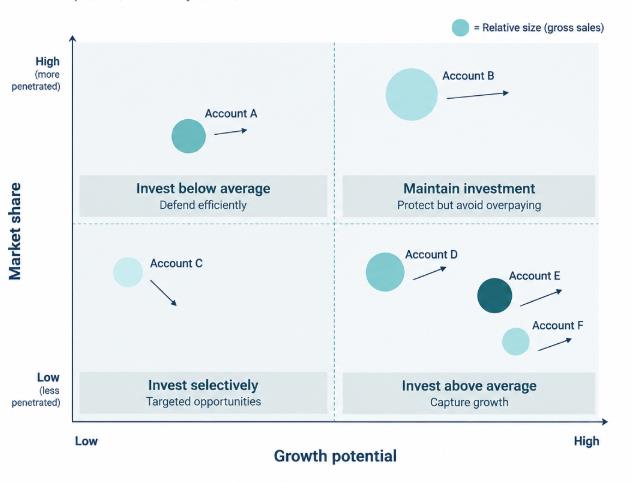
Exhibit 2: Market attractiveness and current position informed differentiated investment priorities
Accounts were segmented by relative market position and growth potential to distinguish where to protect, selectively invest, or accelerate investment
Source: Eendigo Playbook
Impact Delivered
The analysis covered a GTN investment pool of approximately 14% of gross sales.
The identified opportunity indicated that approximately 15-17% of the total GTN pool, could be reallocated within one year toward higher-response products and channels.
Modeled realization scenarios indicated a potential 1-3.5% sales impact and 2-4.5% profit impact, measured against the relevant margin contribution. These estimates represented the potential financial benefit of redirecting investment, subject to implementation, market response, and the assumptions used in the analytical model.
The phased approach was designed to validate these assumptions through controlled execution and measurement before the full opportunity was pursued.
Advice to CEOs
1- Commercial investment should be managed as a portfolio, not as a collection of historical agreements
Discounts, rebates, and other commercial investments are often negotiated one partner or product at a time. Over the years, this can create an allocation that reflects the history of negotiations more than the current opportunities in the market. A distributor with favorable terms may no longer be the partner generating the greatest growth, while a strategically important product or channel may be underfunded.
CEOs should periodically step back from individual agreements and ask where the next unit of commercial investment is likely to generate the greatest return.
2- Revisit contractual arrangements before historical terms become permanent assumptions
Long-standing agreements may remain commercially justified, but they should be reviewed periodically against current market conditions and strategic objectives. A centralized, consistently maintained view of contractual terms can help management identify arrangements that require attention and support more informed negotiations.
3- Bring Sales, Finance and country / regional leadership together around a common fact base
Leadership should bring Sales, Finance, and country or regional teams together around a common fact base. A well-structured discussion around commercial fact base can reveal where a financial opportunity is commercially unrealistic, as well as where a long-standing relationship may be limiting the business’s ability to invest in higher-growth opportunities.
Finance can identify differences in investment levels and profitability, but the numbers alone rarely explain why a distributor receives particular terms or how that partner might react to a change. Sales teams understand these relationships, yet their judgments may also be shaped by historical practices and the understandable desire to protect established accounts. This is why cross-functional discussions to surface commercial and economic opportunities need to be enabled.
4- Elasticity is most useful when it improves judgment, even when it cannot be measured precisely
The central question in commercial investment is how customers, distributors, and competitors will respond if terms change. In practice, the available data may not support a reliable elasticity estimate, particularly when commercial conditions are complex and historical changes have not been controlled.
Rather than treating this uncertainty as a reason to avoid action, management can use proxies and behavioral signals to develop a reasoned view of likely response.
5- Build the governance, tools and processes required to manage commercial investment dynamically
Optimizing commercial investment should not be treated as a one-off analytical exercise. Once investment priorities are defined, companies need a governance framework that ensures continued oversight, regular testing of assumptions, and the ability to adjust allocations as market conditions, distributor performance, and strategic priorities evolve.
Companies need the tools and processes to maintain dynamic visibility into investment levels, contractual terms, customer and distributor performance, and realized economic outcomes. Without this infrastructure, even a well-designed reallocation can gradually revert back to baseline.
At Eendigo, we see this as a natural extension of Gross-to-Net optimization. Beyond identifying where commercial investment can be better deployed, we help companies establish the governance, analytical tools, performance visibility, and management processes required to sustain that optimization over time.
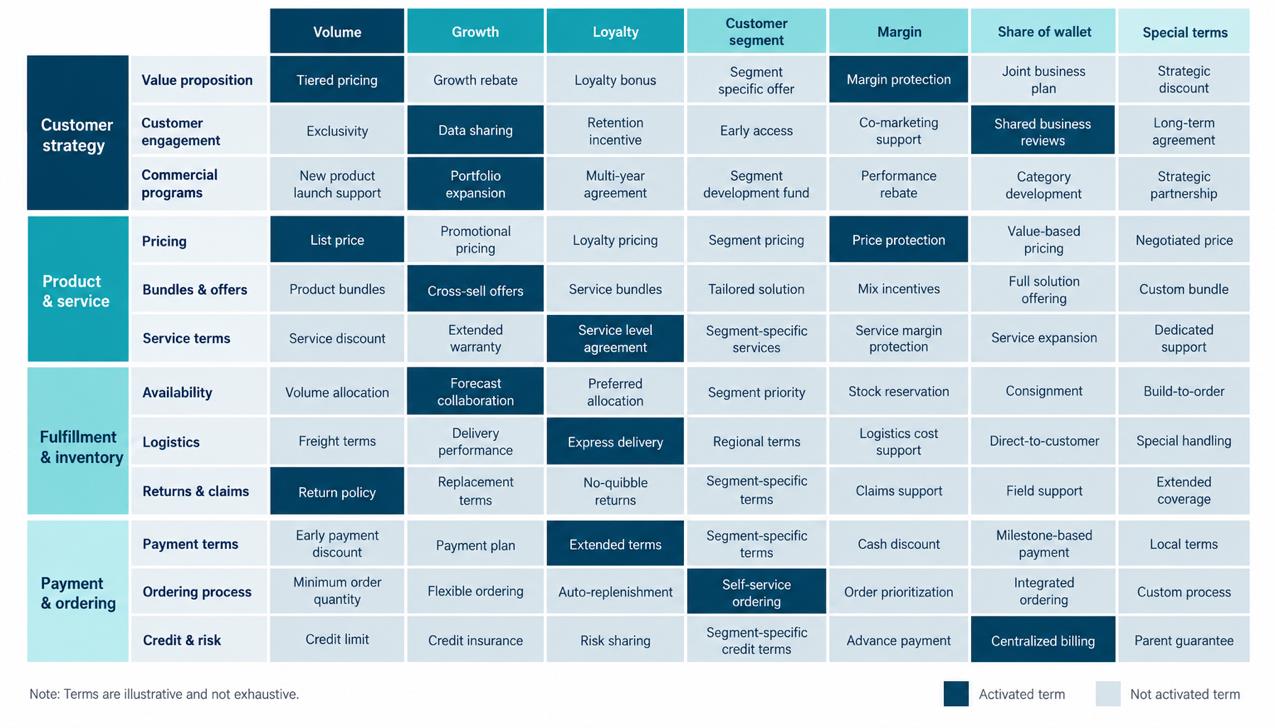
Exhibit 3: A structured view of the commercial terms and conditions across the customer journey helps identify which levers are in place and where there is room for optimization
Commercial terms mapping (Illustrative)
Source: Eendigo Playbook
Get in touch
Email: office@eendigo-ops.com
Website: www.eendigo.com
LinkedIn: linkedin.com/company/eendigo