Uncover margin leakage by rethinking discounts, rebates, and agreements. A structured approach empowers pharmaceutical companies to expand profitability with confidence.
By Eleonora Rabdau, Defne Isler
© Copyright 2025 Eendigo. All Rights Reserved
Pharmaceutical companies face growing challenges in delivering profitable growth. Hospitals demand ever-lower prices through highly regulated public tenders, while wholesale distributors consolidate power through vertical integration. At the same time, European markets remain fragmented, with inconsistent structures and customer dynamics that vary from country to country. In this environment, growth can no longer be achieved simply by pushing more volume into the market. Traditional levers, such as expanding sales coverage or launching incremental products, are no longer sufficient. Without addressing underlying profitability, these actions risk accelerating margin erosion rather than reversing it.
Forward-looking players are beginning to shift from a volume-driven mindset to a value-based commercial strategy. This requires rigorous profitability analytics to move beyond top-line sales figures and uncover the true net margins of customers, products, and channels; smarter contract management that aligns rebates and discounts with measurable performance outcomes rather than blanket concessions; cross-market learning and segmentation to identify where standardized approaches can drive efficiency versus where tailored strategies are essential; and closer integration of commercial and supply chain planning, ensuring that product allocation, pricing, and contracting are optimized against both market needs and margin goals. The companies that succeed are those that rethink how they manage their commercial value chain, starting with the often-overlooked impact of discounts, rebates, and contract agreements.
The Hidden Drain: Gross-to-Net (GtN)
The concept of GtN is deceptively simple: it represents the difference between gross sales and the actual revenue a company retains after deductions such as discounts, rebates, tender conditions, and other commercial terms. On paper, GtN should be a straightforward calculation. In practice, however, it often operates as a “black box” with little transparency or accountability around its drivers.
When companies lack visibility into these components, several issues arise. Profitability blind spots make it nearly impossible to know which markets, products, or customer segments are truly profitable. Weak negotiation positions allow distributors and partners, often with stronger data, to set terms that quietly erode margins. Contract complacency means agreements are set once and rarely revisited, with no systematic reviews of actual financial outcomes. Fragmented decision-making leads managers to rely on intuition instead of fact-based insights, creating inconsistency across countries and channels. Unseen margin leakage accumulates as small variances across customers and markets consume several percentage points of margin, often without detection until performance has already deteriorated. The outcome is a commercial model that looks stable on the surface but silently undermines growth and performance.
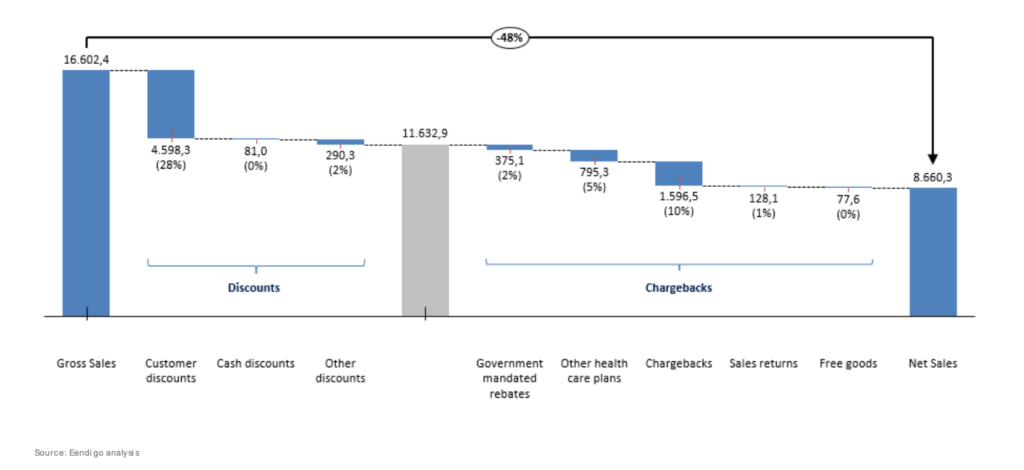
Exhibit 1
Europe currently showcases a 48% Gross-to-Net difference, with customer discounts accounting for 30% of total Gross-to-Net.
Source: Eendigo analysis
Agreement and Discount Analysis: A Strategic Necessity
Agreement and Discount analysis consists of systematically reviewing the structure and impact of commercial terms with partners. It is a strategic lever that brings transparency, consistency, and control into the value chain. A structured approach includes breaking down GtN by component so discounts and rebates are analyzed separately; standardizing reporting across markets to ensure consistency and comparability; consolidating distributor performance through comparative P&Ls; conducting deep dives at country or account level to highlight anomalies and outliers; and benchmarking commercial terms to establish reference points that strengthen negotiations.
What Companies Gain
Organizations that adopt Agreement and Discount analysis realize benefits that go beyond improved reporting. Management gains transparency into profitability, enabling better prioritization of markets, products, and accounts. Commercial teams improve their negotiation power and secure more favorable terms. Channel investments become optimized as profitability insights guide resource allocation between wholesale and retail. Margin leakage is identified and quantified, revealing opportunities for recovery. Ultimately, the practice transforms discounts and rebates from hidden costs into levers for growth.
Looking Ahead
For leaders, the lesson is clear: growth in the generics market demands more than volume expansion. Visibility, control, and discipline across the commercial value chain are essential. Discounts, rebates, and agreements can no longer be considered routine deductions buried in financial statements; they are levers that directly determine profitability and competitive positioning. When managed with rigor, these mechanisms become tools to improve negotiations, secure stronger partnerships, and channel resources toward the markets and customers that create real value.
Embedding structured Agreement and Discount analysis into the decision-making process is not just about financial hygiene, but about creating the clarity and confidence to act decisively. With this transparency, leadership teams can move from reactive concessions to proactive strategies, ensuring that every euro of revenue is defended and every contract contributes to long-term objectives. In a fragmented European landscape, where every percentage point of margin can define success or failure, companies that build this discipline into their DNA will turn margin pressure into a foundation for resilience, agility, and lasting growth.
Get in touch now
Email: office@eendigo-ops.com
LinkedIn: www.linkedin.com/company/eendigo
Delivering impact that lasts.